Monday, January 13, 2014

THE CANAL


Britain is full of canals. It was once the main source for transporting goods because most of the roads were too rough. However with the invention of the railways, the canals fell behind and many fell into disuse and disrepair. Today, however many have been reopened and there are 2,200 miles of navigable canals and rivers across the UK. A narrowboat can use this entire network of canals to move around the country; these are boats up to 7 feet wide and less than 56 feet long. Usually they move at about 4 miles per hour.

While summer is the most popular time for these canal boats and when they are most used for leisure, there are people living on them all year round. While I was staying at Normanton I took the opportunity to walk along a section of the canal. 


YORK

Part of York Castle in the centre of the city.
The city of York lies at the confluence of the Rivers Ouse and Foss in North Yorkshire, England. In AD 71 the Roman Ninth Legion conquered the local Brigantes tribe and built a wooden fort on the site. This was later rebuilt in stone and housed some 6,000 soldiers. A town grew up around the fort and was known as Eboracum. The Roman Emperors Hadrian, Septimus Severus and Constantius I all stayed here at some time. Severus proclaimed it the capital of Britannia Inferior. In 306 AD Constantius died while at York and the garrison soldiers there proclaimed his son as the new Emperor, Constantius the Great. Foundations of the Roman fort lie under the York Minster.

After the Romans left the city declined as it was affected by flooding. It was occupied by the Angles. In the 7th century flooded parts of the city were reclaimed and King Edwin of Northumbria proclaimed it his main city. A minster was built here in 627 for the baptism of Edwin, King of Northumbria. It was replaced by a stone structure a few years later but this soon fell into disrepair and was destroyed by fire in 741. A large structure was built. Over the years the Minster was destroyed, rebuilt and expanded and remodelled a number of times. It is one of the largest of its kind in Northern Europe. It is the seat of the Archbishop of York, the second highest position in the Church of England.

In 866 the Vikings captured York and it eventually developed as a major river port servicing Viking trade routes through-out Europe. It became known as  Jórvík (over time this was shortened to York). The last Viking ruler, Eric Bloodaxe was driven out in 954. York has a terrific Viking museum where tourists can see Viking artefacts and a recreation of what life was like in Jórvík when the Vikings lived there.

York has many features for the tourist. There are a number of museums and old historical buildings. York Castle is a good example of a motte and bailey castle and stands in the middle of the city. York also has more city walls then any other city in Britain. Although these are referred to as the Roman walls, little actually remains of the fortifications built by the Romans. There is also the Shambles, an area of York which is mostly retail shops but where the twisting turning lane ways criss cross and building lean out over the street. And no visit would be complete without afternoon tea at Betty's, a tea room established in the early 1900s.

Constantine the Great
York Minster
Inside York Minster

Diorama of York under the Vikings


A guide at the Jorvik museum


Medieval Guild hall

The Shambles
Betty's tea Rooms
A York squirrel
The river at York


School students in York

Saturday, January 11, 2014

THE HAXEY HOOD


The Fool has been caught and is being taken to the village square to be burnt.
Haxey is a small, friendly village in North Lincolnshire, England. It normally has a population of under 5,000 people and everyone seems to know everyone. Each year on the 6th January Haxey hosts an event known as 'The Haxey Hood'. Villagers from Westwoodside and Haxey dress up and compete for 'the Hood'. This event has been repeated each year for over 700 years making it "Britain's oldest traditional tussle". This year I not only attended to photograph the event but I participated as well.

The Haxey Hood originates from when Lady De Mowbray was riding through the village. Her hat blew off and one of the farm workers retrieved it, but he was too afraid to return it. Another worker took it back to her and she was so delighted she named him 'The Lord of the Hood'. The worker who didn't return it she dubbed 'the fool' and those who had helped in the chase she called 'Boggins'. She also proclaimed that the event should be repeated each year.

So each 6th January the villagers of Westwoodside and Haxey gather in a field and try to 'sway' or push the 'Hood' into one of the four public houses. The winner gets the honour of keeping the Hood until the following year. The event begins with a pub crawl. The fool is dressed like a harlequin and the Lord of the Hood and his Boggins are dressed in red. They go to each of the four pubs, where drinks are had and songs are sang. Songs are rural songs, like Farmer's Boy, John Barleycorn and Drink Old England Dry. I was very pleasantly surprised with how beautifully and passionately these songs were sung.

Then the fool is chased and caught and taken to the village square, where he is ceremonially burnt and the rules of the Hood explained. The crowd then parades to a nearby field and hessian hoods are thrown for youth of the village to scramble over, each containing a two pound bounty. The real Hood, a leather cylinder, is then competed for. This resembled a giant Rugby scrum or maul, but with hundreds of villagers joining the push. It continues until the 'scrum' makes its way to one of the pubs and the hood is handed to the publican.

Although there are hundreds joining in, and many more watching, the whole event is carried out in good spirits. It begins with the following words:    
                                                   Village against village,
                                                    House against house,
                                                    if you meet a man,
                                                    knock him down,  
                                                    but don't hurt him
and that's the way all good sports should be played. Every time people fell over in the melee the whole thing stopped and they were quickly helped to their feet before it continued. As competitors put everything into pushing jokes were cracked, conversations were had and there was even time for more than one person to show me the right way to push so that I didn't get hurt. At one stage the whole 'scrum' broke into a chorus of 'Happy Birthday' for one of the participants. This year the 'Hood' was relatively quick, lasting just over two hours. And although there were a few minor injuries there were no broken legs or arms.

When the Hood reached the village of Haxey, and it was obviously not going to end up in Westwoodside this year, sections of the crowd stared singing "Bye bye Westwoodside", but  any taunts or teasing were extremely good natured. The honours for this year went to the King's Arms, but there really seemed like no winners and no losers......the whole village celebrated well into the night. 

This was an absolutely wonderful event staged by the friendliest village I have ever visited. I had such an enjoyable time and am in debt to Paul and Monica, owners of the Duke William, to their staff, and especially to three of the locals Ian, Craig and Mark who looked after me the whole time I was in Haxey.

The village of Haxey in the morning


Everyone wants to pose with the Fool.
The crowd waits for the Fool to be brought to the square


With the Lord of the Hood.
The Fool with the Hood.
Children grapple for the hessian Hoods


....and so it begins!


Helping out bar staff
Craig, Mark, Ian and myself


Friday, January 10, 2014

BOBBIE

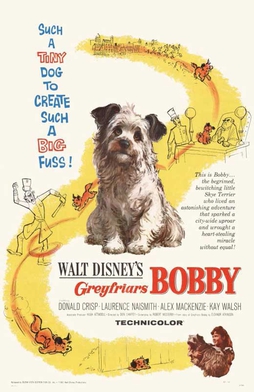
File:GFBposter.jpg
Poster from 1961 movie.
I vividly remember from my childhood the Walt Disney movie 'Greyfriars Bobby'. It was about a dog, a Skye Terrier, named Bobby, whose master had died and was buried at Greyfriars. The loyal dog spent every day lying beside his master's grave. It was pretty special to visit Edinburgh and to be staying just around the corner from Greyfriars. 

The story of Bobby has been kept alive in oral traditions and has become the subject of various books and films. Bobby's owner was John Gray, who worked for the Edinburgh City police as a night watchman. When John Gray died he was buried in the Greyfriars Kirkyard. For the next 14 years his faithful dog, Bobby came and sat by his graveside. In 1867 the Lord Provost of Edinburgh, Sir William Chambers, who was also director of the Scottish Society for Prevention of Cruelty to Animals, paid for Bobby's license and bought him a collar. This collar is in Edinburgh Museum.

Bobby died in 1872 and was buried inside the church yard, near John Gray's grave. A year later Lady Burdett-Coutts had a statue erected of Bobby. The monument of Bobby was created by William Brodie; it is listed as Edinburgh's smallest building. Originally it was a drinking fountain. At the top for humans and at the bottom for dogs. However in 1975 all Edinburgh's fountains were shut down because of health concerns. The statue was daubed in yellow paint in 1979 and then hit by a car in 1984 before being restored that same year. It is claimed to be the most photographed statue in Edinburgh.

Of course there has been much discussion of the story and several attempts to disprove it. In one version Bobby's owner is a farm worker, 'Auld Jock'. It is this version which is used by the Walt Disney movie. Others suggest there was no story and Bobby was just one of many stray dogs which hang around cemeteries all over Britain. A red granite headstone was erected on Bobby's grave in 1981 and many visitors to the cemetery leave sticks, balls and even airline tickets on Bobby's grave (the idea being he spent fourteen years in the cemetery now his spirit can travel the world). 

Statue of Bobby

Greyfriars Kirk

Bobby's headstone.

John Gray's headstone.

Tavern near the Greyfriars Kirk


Thursday, January 9, 2014

EDINBURGH


Edinburgh is the capital city of Scotland. It is the second biggest populated city in Scotland (482,640 in 2012). When I was here I took a tour around the city. It is full of historical buildings and everywhere there is a story. This heart in the pavement represents the heart of the area. It has also become associated with the government and taxes, therefore many Scots will spit on it as they go bye. I watched this happen. Many of the locals won't walk on it but will walk around....so as not to step in the spit.

 This is a typical street scene. The city is full of twisting and turning roads and lane ways. In the centre of many Scottish cities the roads have been made one way. To get to places you need to drive around the block.....though many blocks are irregular. Edinburgh is a very old city and many of these areas still stand. There are little alley ways, stairs and winding streets everywhere. Many of the streets in the Old Town section are also cobbled. Running through the centre is The Royal Mile.
The city is also full of small and large pubs and taverns. The one pictured is billed as the smallest pub in Scotland. It is beside a pub called 'The Last Drop'. Prisoners were hung near here. So its not sure if 'the last drop' refers to prisoners being allowed a drink before they were hung or the actual act of hanging....'the last drop'. Another pub by a woman who was hung for the crime of 'concealing a pregnancy'. She did not die from the hanging and so was free to go, she later prospered.
Edinburgh Castle. The castle is located in the centre of the city on Castle Rock. There has been a castle there since the 12th century and it was used as a royal residence until the Union of the Crowns in 1603. The castle has been successfully and unsuccessfully besieged a number of times. In the 16th century most of the buildings were destroyed by bombardment. These have been rebuilt and the castle is visited by over 1.2 million tourist a year and is the site for the Edinburgh Military Tattoo.
 The Elephant House cafe in Edinburgh. This is where J. K. Rowling wrote some of the chapters for Harry Potter. Although it was claimed that she went to the cafe because it was warmer than her unheated flat she later denied this and said that going for a walk was the best way to get her daughter to fall asleep. Rowling took inspiration for some of the characters in the book from names in the nearby cemetery and the school nearby is a model for the school Harry Potter attended.
 Tour guides touting for business in the city centre. There were a multitude of tours that could be had around Edinburgh. These ranged from historical tours, ghost tours, underground tours to pub crawls. A number of the tours were free and people who went on them were simply asked to tip what they thought the tour was worth. I good tour operator could make an above average wage just from the tips.....and it seemed this was all cash in hand. the tour I did go on was excellent.

 A city busker.  I did see a number of buskers on the streets of Edinburgh. There were groups performing and even a punk rocker, complete with spiked mohawk hair-cut but singing beautiful folk songs in Gaelic. More noticeable were the homeless beggars on the streets. This appeared the same in every Scottish city I visited. Men and sometimes women would sit in the street in the cold with cups or a hat in front of them. maybe this is not surprising as the rate of unemployment amongst the youth is extremely high.

This was a skating ring in the open in the middle of Edinburgh. It was part of the Christmas markets which seem to have been operating for about two weeks. They included all sorts of side stalls, each stall having its own little shed or hut. There were also a number of giant ferris wheels and rides which propelled people high into the sky. They were well attended despite the cold and the extreme winds that were frequent across the country.