Showing posts with label York. Show all posts

Monday, January 13, 2014

YORK

Part of York Castle in the centre of the city.
The city of York lies at the confluence of the Rivers Ouse and Foss in North Yorkshire, England. In AD 71 the Roman Ninth Legion conquered the local Brigantes tribe and built a wooden fort on the site. This was later rebuilt in stone and housed some 6,000 soldiers. A town grew up around the fort and was known as Eboracum. The Roman Emperors Hadrian, Septimus Severus and Constantius I all stayed here at some time. Severus proclaimed it the capital of Britannia Inferior. In 306 AD Constantius died while at York and the garrison soldiers there proclaimed his son as the new Emperor, Constantius the Great. Foundations of the Roman fort lie under the York Minster.

After the Romans left the city declined as it was affected by flooding. It was occupied by the Angles. In the 7th century flooded parts of the city were reclaimed and King Edwin of Northumbria proclaimed it his main city. A minster was built here in 627 for the baptism of Edwin, King of Northumbria. It was replaced by a stone structure a few years later but this soon fell into disrepair and was destroyed by fire in 741. A large structure was built. Over the years the Minster was destroyed, rebuilt and expanded and remodelled a number of times. It is one of the largest of its kind in Northern Europe. It is the seat of the Archbishop of York, the second highest position in the Church of England.

In 866 the Vikings captured York and it eventually developed as a major river port servicing Viking trade routes through-out Europe. It became known as  Jórvík (over time this was shortened to York). The last Viking ruler, Eric Bloodaxe was driven out in 954. York has a terrific Viking museum where tourists can see Viking artefacts and a recreation of what life was like in Jórvík when the Vikings lived there.

York has many features for the tourist. There are a number of museums and old historical buildings. York Castle is a good example of a motte and bailey castle and stands in the middle of the city. York also has more city walls then any other city in Britain. Although these are referred to as the Roman walls, little actually remains of the fortifications built by the Romans. There is also the Shambles, an area of York which is mostly retail shops but where the twisting turning lane ways criss cross and building lean out over the street. And no visit would be complete without afternoon tea at Betty's, a tea room established in the early 1900s.

Constantine the Great
York Minster
Inside York Minster

Diorama of York under the Vikings


A guide at the Jorvik museum


Medieval Guild hall

The Shambles
Betty's tea Rooms
A York squirrel
The river at York


School students in York

Saturday, November 16, 2013

MEDIEVAL FEASTING


The Medieval Feast was held on the Saturday night at York. Although the fair had been held for a number of years, this was only the second year that they had held the feast. One of the re-enactment groups provided security and continual entertainment throughout the night, and an Irish band provided the music. At the entrance two men-at-arms barred the way until tickets were checked. Mock arguments and fights broke out amongst the re-enactors and this kept the waiting queue entertained. Medieval maidens escorted you to your seats and there were medieval entrees and mead to whet your appetite.

The layout, table decorations and food were brilliant. The organisers did a fantastic job.

At the feast I started to take some photographs. One of these was of a court jester. It turned out he was one of the organisers. One thing led to another and somehow I became the official photographer for the night, so groups were coming to me to pose for the photos. The majority of guest were wearing some sort of medieval clothing. In fact because I wasn't in medieval garb (mine was back in NSW) it was suggested I try a large mouthful of the special cheese. It turned out to be butter.... a trick because I wasn't dressed appropriately.

The entertainment continued without a break all night. At times there were mock fights, an attempted assassination, music, juggling and a remarkable display of juggling with fire. The 180 guests had a wonderful time and this feast is worth travelling to Western Australia for next year.


Friday, November 15, 2013

YORK MEDIEVAL FAIR


On the drive up to Mount Gibson I had stayed one night at a town called York. The old style building gave the town a lot of charm and the next morning I spent taking photographs of the main street. After Monkey Mia I returned to York as they were holding a Medieval Feast and a Medieval fair. The feast was on the Saturday night and the fair on the Sunday.

The fair had a number of stalls selling medieval type goods, such as archery gear, jewellery, recreated swords and daggers, heraldic symbols and stickers and lots of food. There were also a number of re-enactment groups providing fighting and craft displays. For the kids there were modified fighting battles and these were proving very popular and were well organised. Regular fair ground games were replaced with medieval ones. Miniature catapults fired 'soft' rocks to try to knock down small targets. Tourists and fair goers could also have their picture taken in the village stocks and be labelled 'witch' 'village idiot' or 'thief'. 

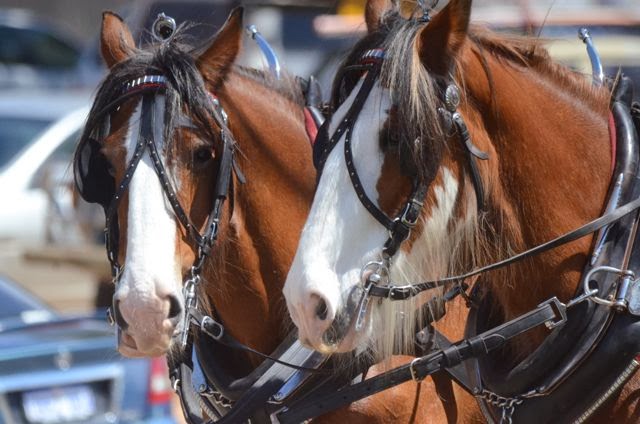
There was also a king and queen for the fair and they mad their royal entrance on a wagon drawn by two large clydesdale horses. All day the crowds were entertained with live 'medieval' music, wandering street performers and even belly dancers. It was a good fair and being so close to Perth I am sure in the future it will become a popular event.

Making chain mail

Children's catapults